
- What Executive Meeting Notes Are
- Why Leadership Meetings Fail Without Structured Notes
- Executive Meeting Notes vs Standard Meeting Minutes
- The Executive Action Clarity Framework
- Executive Meeting Notes Templates by Leadership Context
- Digital vs Handwritten Notes in Executive Settings
- AI-Powered Executive Meeting Notes Workflow
- Manual vs AI-Assisted vs Hybrid Executive Notes
- How Executive Meeting Notes Improve Outcomes
- Voice-First Infrastructure for Executives
- FAQ
- Final Thoughts
How Executives Take Better Meeting Notes
Executive meeting notes are structured decision systems that capture what was decided, who owns execution, and when follow-up occurs.
They are not records of discussion. They are control mechanisms for leadership teams operating under time pressure, complexity, and accountability risk.
In modern organizations, executives move through overlapping leadership meetings across strategy, operations, and cross-functional alignment. When executive meeting notes are inconsistent or informal, decisions fragment, action items decay, and accountability weakens. The cost is rarely visible immediately. It appears weeks later as rework, follow-up meetings, and missed commitments.
This guide defines executive meeting notes as leadership infrastructure. It introduces a repeatable decision framework, executive-grade templates, and an AI-assisted voice-to-text workflow designed to convert conversations into coordinated execution.
What Executive Meeting Notes Are
Executive meeting notes are decision-focused records that capture strategic context, finalized decisions, assigned owners, and follow-up timelines in a structured format.
Their purpose is execution clarity, not documentation completeness.
Unlike traditional notes or transcripts, executive meeting notes are designed to reduce interpretation variance across leadership teams. They separate discussion from outcomes and make ownership explicit.
Core characteristics include:
- Clear distinction between discussion and final decisions
- Explicit action items with named owners
- Defined deadlines and review checkpoints
- Strategic context and implications captured at the decision level
- Centralized storage for long-term reference and accountability
Executives operate under sustained cognitive load. Relying on memory, informal summaries, or fragmented emails introduces silent execution risk. Structured executive meeting notes function as an external memory system that preserves intent and enforces follow-through.
Why Leadership Meetings Fail Without Structured Notes
Leadership meetings rarely fail because of disagreement. They fail because of ambiguity after the meeting ends.
When executive meeting notes lack structure, several predictable breakdowns occur.
Decision ambiguity
Participants remember outcomes differently. Without a written decision statement, alignment erodes within days.
Accountability gaps
Action items are discussed but not formally assigned. Owners assume someone else is responsible. Deadlines drift.
Cross-functional friction
Teams interpret outcomes through departmental context. Without a shared reference, misalignment multiplies.
Cognitive overload
Executives attend multiple meetings daily. Relying on recall increases error rates and follow-up overhead.
Structured executive meeting notes create a shared source of truth. They reduce re-litigation, prevent memory drift, and convert meetings from discussion forums into execution engines.
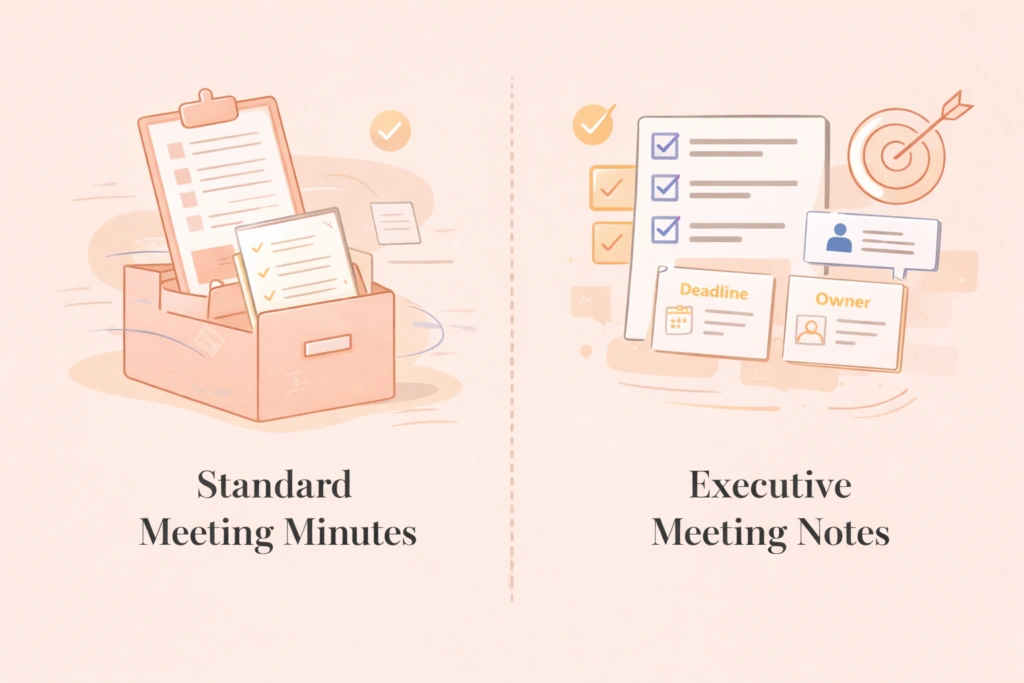
Executive Meeting Notes vs Standard Meeting Minutes
Understanding this distinction is critical for leadership teams.
Standard Meeting Minutes
- Chronological summaries of discussion
- Emphasis on who said what
- Compliance or record-keeping oriented
- Passive documentation
- Limited execution value
Executive Meeting Notes
- Decision-driven structure
- Explicit separation of discussion and outcomes
- Formalized decisions in final language
- Action items with owners and deadlines
- Designed for execution and accountability
Standard minutes answer what happened.
Executive meeting notes answer what was decided, who owns it, and what happens next.
In leadership environments, documentation without execution leverage creates false clarity. Executives do not need more records. They need operational control.
The Executive Action Clarity Framework
To operationalize executive meeting notes, leadership teams need a consistent system. The Executive Action Clarity Framework converts raw discussion into structured execution components that scale across meetings and teams.
1. Meeting Context
- Date and meeting type
- Participants and decision authority
- Strategic objective
- Relevant pre-reads, dashboards, or documents
Capturing context anchors decisions to intent and reduces misinterpretation weeks later.
2. Final Decisions
- Decision written in finalized language
- Scope and constraints clarified
- Rationale summarized briefly
Only finalized decisions belong here. Discussion does not.
3. Action Ownership
- Action description
- Single directly responsible owner
- Supporting stakeholders if applicable
Each action must have one accountable owner. Shared ownership is a signal of unclear responsibility.
4. Strategic Implications
- Impact on roadmap or priorities
- Budget or resource implications
- Risk considerations
- Cross-team dependencies
This prevents decisions from being treated as isolated tasks.
5. Follow-Up Timeline
- Deadlines
- Review checkpoints
- Next leadership touchpoint
Execution drifts without explicit follow-up structure. This section closes the loop.
Used consistently, the Executive Action Clarity Framework turns meeting notes into a governance mechanism rather than an administrative artifact.

Executive Meeting Notes Templates by Leadership Context
Different leadership environments require different note structures. Below are executive meeting notes templates optimized for common contexts.
Personal Leadership and One-on-One Meetings
Used for executive reflections, mentoring, and private leadership discussions.
- Context and Links
Dashboards, board materials, performance reports - Key Issues
Strategic risks, talent considerations, unresolved questions - Decisions Made
Final calls and deferred decisions - Personal Action Items
Owner, deadline, dependencies
This template supports executive productivity and reduces reliance on scattered reminders.
Recurring Leadership Team Meetings
Used for weekly or monthly executive syncs.
- Agenda Overview
Pre-circulated topics and time allocations - Discussion Summary
Key points only - Decision Register
Final decisions in clear language - Action Tracker
Task, owner, due date
Separating decisions from discussion prevents ambiguity and simplifies follow-up.
Cross-Functional Executive Meetings
Used when alignment risk is highest.
- Department Snapshots
Current status, constraints, key metrics - Dependencies and Conflicts
Resource overlaps, timing issues, policy constraints - Unified Decisions
Single authoritative phrasing agreed by all parties - Shared Action Tracker
Cross-team actions with owners and review cadence
Cross-functional friction often originates from inconsistent interpretation. Structured executive meeting notes formalize alignment and reduce political friction.
Digital vs Handwritten Notes in Executive Settings
Handwritten note taking improves comprehension and presence during meetings. Writing by hand engages deeper cognitive processing.
However, handwritten notes introduce execution risk:
- Slower capture
- Difficult sharing
- Limited visibility
- Private silos
Digital executive meeting notes enable:
- Faster capture
- Immediate distribution
- Centralized archiving
- Searchability and retrieval
In leadership environments, visibility and shared access often outweigh cognitive benefits. A hybrid approach is common.
- Capture freely during or immediately after the meeting
- Convert into structured executive meeting notes
- Archive centrally in tools such as Notion or Google Docs
- Share selectively with relevant stakeholders
Avoid storing executive notes in email threads. Email fragments institutional memory and weakens accountability.
AI-Powered Executive Meeting Notes Workflow
AI and voice-to-text shift executive meeting notes from manual effort to structured automation. When designed correctly, AI becomes a core layer of the workflow rather than an add-on.
Step 1: Voice Capture
Executives dictate key points during or immediately after meetings. Voice capture preserves nuance and reduces cognitive loss.
This is especially effective:
- Between back-to-back meetings
- During travel or walking transitions
- After high-stakes cross-functional discussions
Step 2: Transcription Layer
AI transcription converts raw audio into text. Recorded calls from platforms such as Microsoft Teams can serve as raw input.
Transcripts are not final notes. They are source material.
Step 3: Structured Conversion
AI tools like ChatGPT convert raw transcripts into structured executive meeting notes:
- Decision lists
- Action items with owners
- Timelines and follow-up checkpoints
This step accelerates formatting, not thinking.
Step 4: Collaboration and Confirmation
- Refine notes in shared documents
- Confirm ownership in tools like Slack
- Send formal summaries through Microsoft Outlook
Step 5: Central Archive
Store finalized executive meeting notes in a centralized system for retrieval and governance.
Manual vs AI-Assisted vs Hybrid Executive Notes
| Approach | Speed | Clarity | Scalability | Risk |
|---|---|---|---|---|
| Manual typing | Low | Medium | Low | High cognitive load |
| AI-assisted | High | Medium | High | Over-reliance risk |
| Hybrid system | High | High | High | Lowest |
The hybrid model combines executive judgment with AI acceleration. It delivers speed without sacrificing clarity.
How Executive Meeting Notes Improve Outcomes
Structured executive meeting notes produce measurable benefits:
- Reduced follow-up meetings
- Faster execution cycles
- Clear accountability
- Improved cross-functional alignment
- Lower cognitive overhead for leaders
When decision visibility increases, execution accelerates. Control is established after the meeting, not during it.
Voice-First Infrastructure for Executives
For leaders who prefer dictation, a voice-to-text layer further reduces friction.
Tools such as VoiceDash allow executives to dictate reflections and decisions across applications. When integrated into a structured workflow, voice-first capture compresses the time between conversation and execution.
Voice tools do not replace structured thinking. They shorten the path to structured notes.
FAQ
What should executive meeting notes include?
Executive meeting notes should include meeting context, finalized decisions, action items with named owners, deadlines, and follow-up checkpoints. Discussion summaries are secondary. The primary objective is execution clarity and accountability.
Are executive meeting notes different from AI meeting notes?
AI meeting notes often capture transcripts or summaries automatically. Executive meeting notes are decision-driven and require structured conversion. AI accelerates capture and formatting but does not replace executive judgment.
How do leaders automate executive meeting notes?
Leaders automate capture through voice-to-text, convert transcripts into structured notes using AI, and store results in centralized systems. Automation works best when paired with a defined framework.
Should executive meeting notes be shared?
Decisions and action items should be shared with relevant stakeholders. Personal reflections may remain private. Visibility reduces ambiguity and improves execution.
What is the best executive meeting notes template?
The best template separates context, decisions, action ownership, strategic implications, and follow-up timelines. Templates should adapt slightly by meeting type but remain structurally consistent.
Final Thoughts
Executive meeting notes are leadership infrastructure. When treated as a system rather than an afterthought, they convert conversations into coordinated execution and enable leadership teams to operate with clarity, speed, and accountability.
