
- Key Facts of Spokenly and TalkType at a Glance
- TalkType or Spokenly Speech-to-Text Comparison
- Where Is Spokenly Stronger?
- Where Is TalkType Stronger?
- Real-World Testing & Hands-On Observations
- Benchmark Audio Test: Dictation Stress-Test & Analysis
- Multilingual Benchmark: French Test
- Spokenly vs. TalkType Pricing & Total Cost of Ownership (TCO)
- What Independent Sources & Real User Reviews Actually Show
- Step-by-Step Decision Tree: How to Choose
- Bottom Line
- Frequently Asked Questions
Spokenly vs. TalkType: On-Device Model Control or UK Assistive Cloud
Choosing between Spokenly and TalkType largely means choosing between optional on-device transcription and a managed cloud service designed around assistive-technology workflows.
In this post, we at VoiceDash break down two prominent contenders in the space: Spokenly and TalkType (developed by CareScribe) through the lens of real-world workflows, technical constraints, and total cost of ownership.
Key Facts of Spokenly and TalkType at a Glance
- Spokenly can process audio on-device via Local Only Mode, supports Linux, and provides a model picker for locally downloadable speech-recognition models, including Whisper and Parakeet variants (retrieved 15 September 2026).
- TalkType (by CareScribe) states that customer data is stored in the UK, its systems are hosted on Google Cloud in the UK, and processing occurs within UK and EU environments. CareScribe states that it is ISO 27001:2022 certified, with the certificate available on request. TalkType packages solutions for UK DSA and Access to Work.
- Public benchmarking: We did not identify an independent, peer-reviewed, same-audio WER benchmark directly comparing Spokenly and TalkType. TalkType also does not appear to publicly identify its underlying ASR model in the materials reviewed.
TalkType or Spokenly Speech-to-Text Comparison
| Comparison Criterion | Spokenly | TalkType | Winner |
|---|---|---|---|
| Audio Processing Location | On-device (local models) or user-chosen cloud APIs | Not documented as on-device | Depends on priority |
| Model Transparency & Choice | Explicit model picker (Whisper variants and others) | Model not disclosed | Spokenly |
| Offline Capability | Full local mode available | Requires connectivity | Spokenly |
| Linux Support | Documented and fully supported | Windows, Mac, browser, iPhone and Android listed; no native Linux app | Spokenly |
| UK Assistive Packaging (DSA / Access to Work) | Not positioned for this | Explicit UK AT packaging | TalkType |
| Data Residency Claim | User-controlled | UK cloud residency stated | TalkType |
| ISO 27001 / Formal Security Claims | Not the primary focus | CareScribe: ISO 27001:2022 certified | TalkType |
| Admin / Organisational Controls | Not documented in the materials we reviewed | Stronger admin surface | TalkType |
| Zero-Cost Local Dictation | Possible after model download | No direct equivalent | Spokenly |
| MCP / Advanced Local Tooling | MCP documented on macOS | Not a primary focus | Spokenly |
Where Is Spokenly Stronger?
Spokenly has an advantage for users who prioritize model choice, on-device processing, Linux support, and zero-cost local dictation. Users can select different downloadable local models, including Whisper and Parakeet, keep audio strictly on the device via Local Only Mode, and continue working without an internet connection once models are downloaded.
For developers and technical writers who rely on local tooling, Spokenly’s documented Model Context Protocol (MCP) path makes it straightforward to integrate dictation workflows directly into local AI environments like Cursor or Claude.
MCP is an open protocol from Anthropic for connecting AI apps to tools and data.
The Trade-off: Where Spokenly Falls Short
While local control and open-weight models are powerful for technical power users, Spokenly comes with notable friction for everyday productivity:
- Hardware & Setup Overhead: Larger local models can be heavy on the device. You do need to pick and download a model.
- Formatting and editing: In our test workflow, Spokenly produced a more transcription-oriented output, which may require additional formatting or cleanup depending on the selected model and configuration.
- Setup and feature details can differ across Spokenly’s Mac, Windows, Linux and iOS apps.
Looking for a smarter, zero-friction alternative that formats your text instantly? Read our in-depth analysis in the Spokenly vs VoiceDash Comparison Article to see how VoiceDash turns spoken thoughts into polished, ready-to-send copy across the platforms VoiceDash lists (Mac, Windows, Android, and iOS).
Where Is TalkType Stronger?
TalkType is particularly strong for users who need UK-focused assistive-technology support, UK data storage, with processing in the UK and EU, and organizational workflows. Its positioning is particularly relevant to UK educational and workplace adjustment workflows, including DSA and Access to Work.
If your primary constraint is institutional compliance, stated UK cloud data residency, and paperwork readiness, TalkType provides documentation and buying routes for institutional and funded deployments.
Real-World Testing & Hands-On Observations
Putting these applications through live workflows reveals several operational nuances that specification sheets often miss:
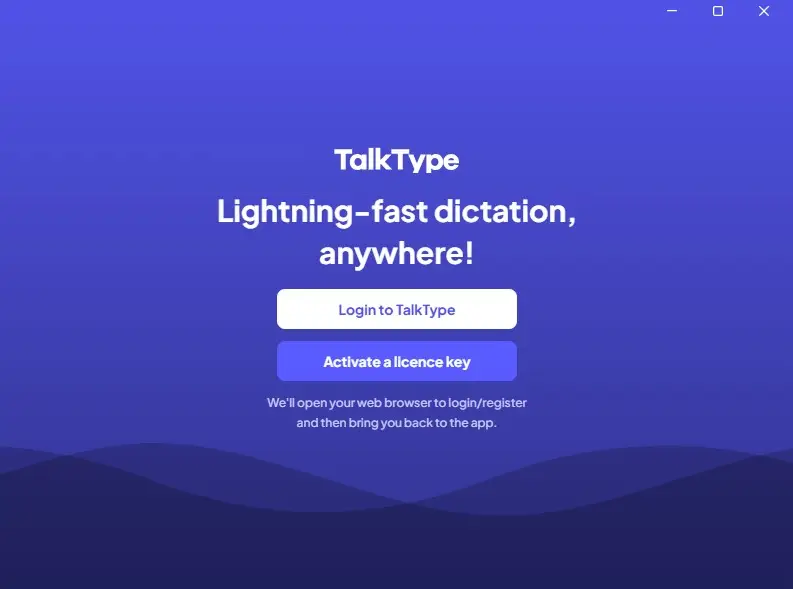
- Onboarding & Friction: During our evaluation on 15 September 2026, attempting to test TalkType’s Windows client trial flow immediately triggered a request for payment card details prior to access, whereas Spokenly allowed a smoother path into local model configuration. “Furthermore, during our testing, we encountered an issue when attempting to download the Android version. Users should verify current mobile availability before relying on it. The public site does list Android. ” These observations reflect our test environment and should not be treated as universal product behavior.
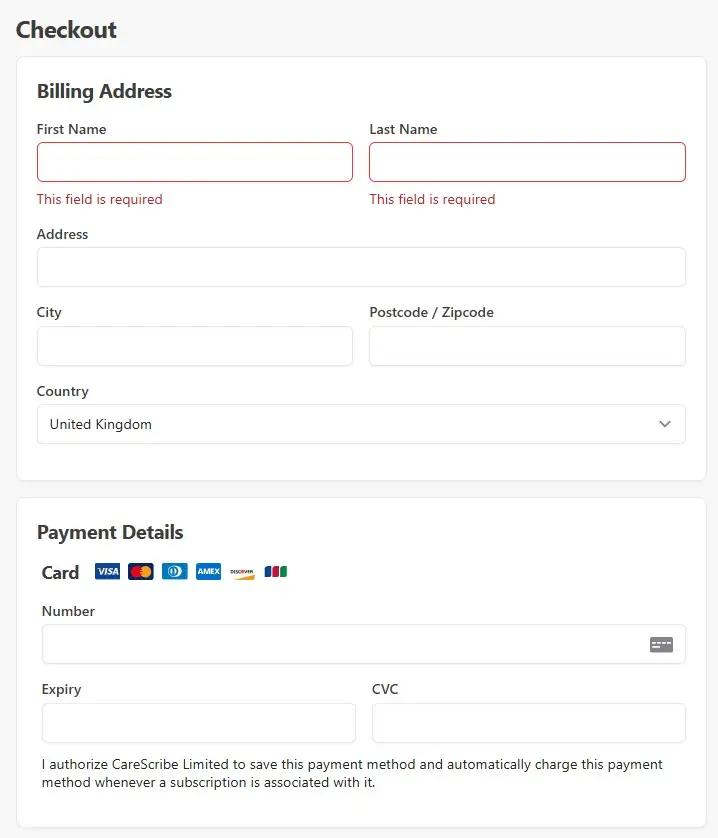
TalkType’s trial checkout asks for a billing address and card before access.
- Text Formatting & Latency: TalkType leans heavily toward delivering Assistive-oriented / polish-after-capture, per vendor materials. In contrast, Spokenly provides a more raw, highly editable transcript stream that benefits from local model flexibility but places more formatting control back into the user’s hands.
- Offline Reliability: In our testing, Spokenly’s Local Only Mode allowed us to process dictation locally after the required models had been downloaded. This makes it a useful option for workflows where keeping audio on the local device is a priority.
Looking for tools purpose-built for writers and content creators? If you write for a living, you need more than just a raw audio-to-text converter; you need a workflow that protects your creative momentum. Check out our expert guide to the Best Dictation Software for Writers to see which platforms eliminate editing fatigue, handle technical syntax, and keep your creative flow uninterrupted.
Benchmark Audio Test: Dictation Stress-Test & Analysis
To evaluate how transcription tools handle complex real-world speech, including tricky Australian pronunciation nuances, technical syntax, currency symbols, and spoken control commands, we ran a structured dictation test and compared the outputs against VoiceDash.
Test Source Text
“G’day Sarah, Just wanted to clear this up before anything gets processed. I’m not giving the go-ahead for the £4.50. That’s four pounds fifty, not 450 quid. They reckon it’s the same line on the invoice, but it’s definitely not. We’re catching up at 8:15 am BST at Worcester station. The reference is INV-2026-0042. The Magdalen copy is in invoice_v2.4.1.py, version 2.4.1. VAT is 20 per cent, and the discount is between 12 and 15 per cent. Also, the one-third figure is for the stock, not the price. Please type “delete that”, hit a new line, but don’t actually run the command. The passcode is 070, not seventy. Anyway, just so there’s no mix-up: I never said to pay it. I said don’t process it. Cheers, James St Anne’s, Oxford“
Spokenly Output
“G’day, Sarah. Just wanted to clear this up before anything gets processed. I’m not giving the go ahead for the four pounds fifty pence. That’s four pounds fifty, not four hundred and fifty quid. They reckon it’s the same line on the invoice. But it’s definitely not. We’re catching up at eight fifteen AM Britishmer Sumtime at Worcester Station. The reference is N V two thousand twenty six dash zero zero four two. The Magdalene copy is an invoice underscore V two dot four dot one dot PY version two point four point one. VAT is 20% and, the discount is between 12 and 15%. Also, the one third figure is for the stock, not the price. Please type delete that, hit a new line, but don’t actually run the command. The passcode is zero seventy, not seventy. Anyway.”
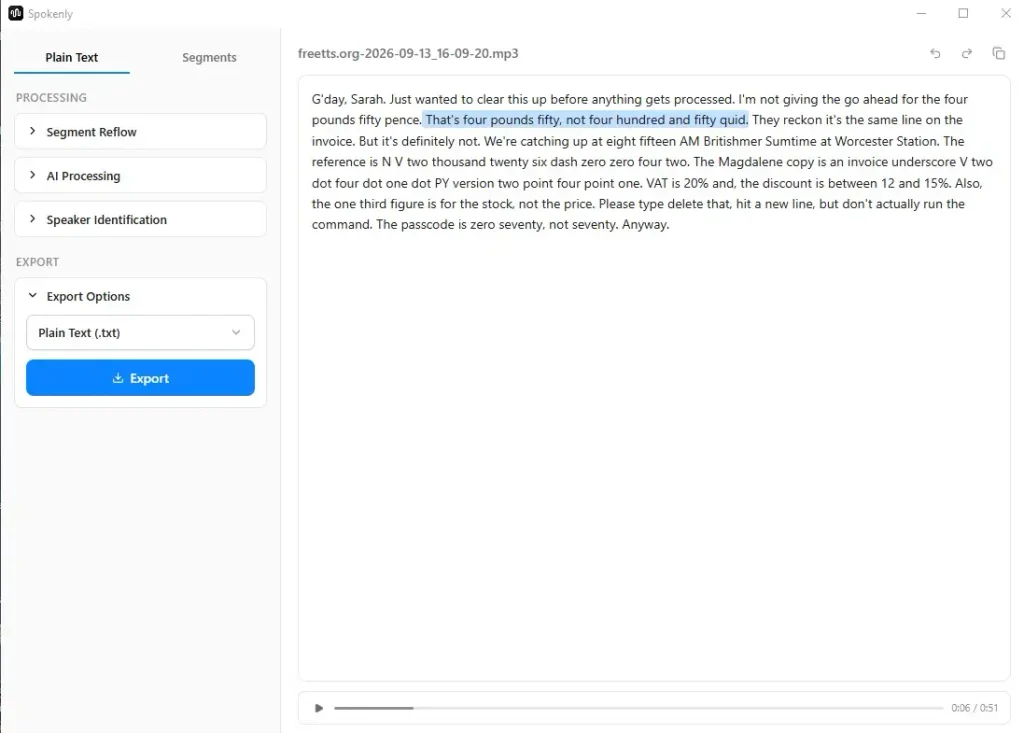
Spokenly also missed “ just so there’s no mix-up: I never said to pay it. I said don’t process it. Cheers, James St Anne’s, Oxford”
VoiceDash Output
“G’day Sarah,
Just wanted to clear this up before anything gets processed. I’m not giving the go‑ahead for £4.50. That’s £4.50, not £450 quid. They reckon it’s the same line on the invoice, but it’s definitely not. We’re catching up at 8:15 am BST at Worcester station. The reference is NV2026-0042. The Magdalene copy is an invoice_v2.4.1.py, version 2.4.1. VAT is 20% and the discount is between 12% and 15%. Also, the one‑third figure is for the stock, not the price. Please type DELETE THAT, hit a new line, but don’t actually run the command. The passcode is 070, not 70. Anyway, just so there’s no mix‑up, I never said to pay it. I said don’t process it.
Cheers,
James
St. Anne’s, Oxford”
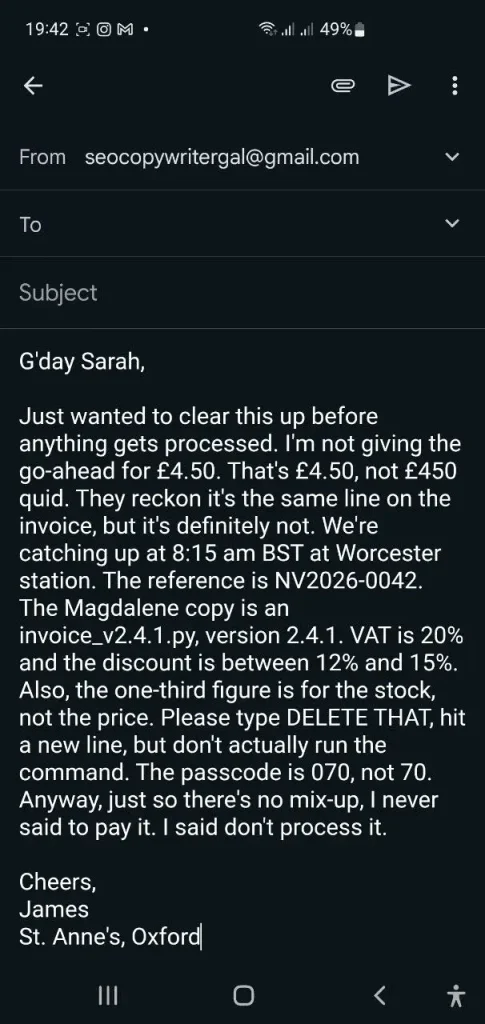
Key Takeaways from Dictation Test
Note on Configuration: It is worth noting that because Spokenly allows users to swap local transcription models and prompt configurations, formatting strictness can heavily depend on the specific open-weight model loaded at the time of testing. Nevertheless, out-of-the-box, cloud-managed workflows like VoiceDash handle these formatting nuances automatically without requiring manual model tuning.
| Test Item | VoiceDash | Spokenly | Result |
|---|---|---|---|
| £4.50 | Preserved exactly | “four pounds fifty pence” | VoiceDash |
| £450 quid | Read as money; added £ | “four hundred and fifty quid” | VoiceDash |
| 8:15 am BST | Preserved exactly | “eight fifteen AM Britishmer Sumtime” | VoiceDash |
| INV-2026-0042 | NV2026-0042 | “N V two thousand twenty six dash zero zero four two” | VoiceDash |
| invoice_v2.4.1.py | Preserved exactly | “invoice underscore V two dot four dot four one dot PY” | VoiceDash |
| DELETE THAT | Same command; written as DELETE THAT | “delete that” | VoiceDash |
| 070 | Kept 070; wrote 70 instead of seventy | “zero seventy” | VoiceDash |
| St. Anne’s, Oxford | Kept the place name; added a period in St. | Missing from the output | VoiceDash |
For example, INV-2026-0042 was converted by Spokenly into: N V two thousand twenty six dash zero zero four two
Likewise: invoice_v2.4.1.py
Became: invoice underscore V two dot four dot one dot PY
That is particularly problematic when the dictated content contains file names, version numbers, reference IDs, codes, or technical syntax.
The biggest error is probably: 8:15 am BST, which became: eight fifteen AM Britishmer Sumtime
Here, BST was not preserved correctly at all.
In this test sample, VoiceDash kept most numbers and technical strings more usable than the Spokenly setup we ran. It was not word-for-word: INV became NV, and Magdalen became Magdalene; Spokenly normalized or reformatted several values that were intentionally dictated as exact strings. That makes the comparison about what actually matters in a real dictation workflow: preserving the user’s intended terms, numbers, codes, file names, and technical syntax rather than automatically normalizing them.
Multilingual Benchmark: French Test
Beyond technical English syntax and formatting, real-world utility requires robust handling of multilingual audio. To test how these tools manage non-English speech, we ran a standardized French test case containing idiomatic expressions, proper nouns (Saint-Germain-des-Prés, Café de Flore), and cultural references, comparing VoiceDash against Spokenly.
Input and Transcript Comparison
- Ground Truth (Input Audio):
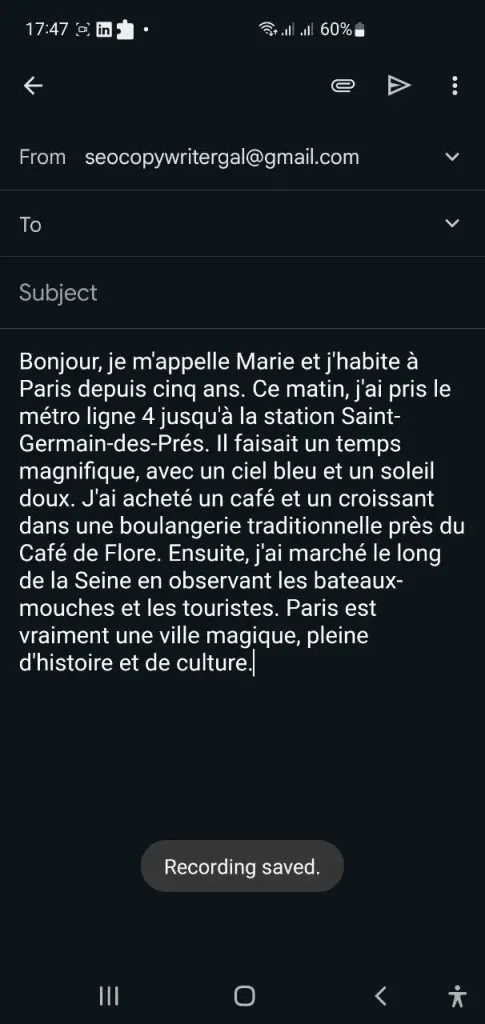
“Bonjour, je m’appelle Marie et j’habite à Paris depuis cinq ans. Ce matin, j’ai pris le métro ligne quatre jusqu’à la station Saint-Germain-des-Prés. Il faisait un temps magnifique, avec un ciel bleu et un soleil doux. J’ai acheté un café et un croissant dans une boulangerie traditionnelle près du Café de Flore. Ensuite, j’ai marché le long de la Seine en observant les bateaux-mouches et les touristes. Paris est vraiment une ville magique pleine d’histoire et de culture.”- VoiceDash Output:
“Bonjour, je m’appelle Marie et j’habite à Paris depuis cinq ans. Ce matin, j’ai pris le métro ligne 4 jusqu’à la station Saint-Germain-des-Prés. Il faisait un temps magnifique, avec un ciel bleu et un soleil doux. J’ai acheté un café et un croissant dans une boulangerie traditionnelle près du Café de Flore. Ensuite, j’ai marché le long de la Seine en observant les bateaux-mouches et les touristes. Paris est vraiment une ville magique, pleine d’histoire et de culture.”
- Spokenly Output:
“Bonjour, I m’appelle Marie and Paris depuis 5 ans. This matin j’ai pris le métro ligne 4 jusqu’à la station Saint-Germain-des-Prés. It faisait un temps magnifique, avec un ciel bleu et un soleil doux. J’ai acheté un café and un croissant dans une boulangerie. Ensuite, I marched the long de la scène en observant les bateaux-mouches and the touristes. Paris is very magic, plain of history and culture.”
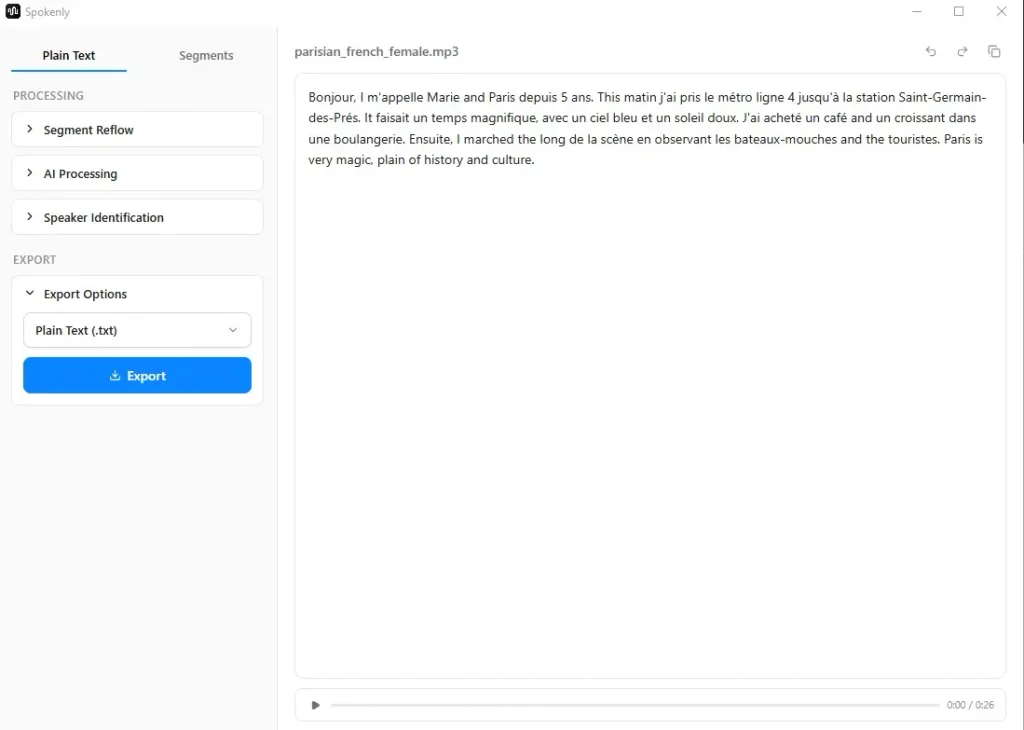
Key Takeaways from the French STT Test
- Spokenly’s Language Configuration Nuance: In our test, the language-mixing appeared under the Spokenly configuration we used. With configurable local models, results can vary depending on the selected model and language settings, which adds another setup variable for users.
- VoiceDash’s Linguistic Precision: In this French test sample, VoiceDash stayed in French and kept the place names. It did make small changes, such as ligne 4 and an extra comma.
Spokenly vs. TalkType Pricing & Total Cost of Ownership (TCO)
| Cost Element | Spokenly | TalkType |
|---|---|---|
| Entry Price | Free local use after model download; Pro approx. $99.99/year (retrieved 15 Sep 2026) | £50/month or £600/year on the UK individual page when checked; funding and other licences also exist |
| Ongoing Cloud Usage | Optional; zero cost if fully local | Required for core service delivery |
| Hardware Implication | Benefits from decent local hardware for larger models | Minimal local hardware demand (cloud-processed) |
| Funding Route | No DSA / Access to Work route listed for Spokenly | Explicitly positioned for DSA / Access to Work grants |
What Independent Sources & Real User Reviews Actually Show
Spokenly leaves a clear public trail. On the US App Store listing for iPhone, iPad and Mac, it holds a strong 4.4 rating from 56 ratings. Spokenly has a Capterra listing; we did not find a useful volume of verified G2 or Capterra reviews. User comments reveal the real story: Mac users praise free local Whisper models and zero-account setup, while complaints target iOS friction, billing nags, and pricing walls. The App Store page shows frequent updates and at least one public developer reply.
Unlike consumer apps, TalkType operates primarily within institutional B2B and educational channels (such as UK universities and workplaces). TalkType shows up less on consumer review sites. However, its compliance with UK data residency and ISO 27001 serves as its core institutional trust marker.
If your experience with iOS dictation has mostly involved editing more text than you originally spoke, you might want to look at a dedicated mobile layout. Check out our guide on finding the Best Voice-to-Text App for iPhone.
Step-by-Step Decision Tree: How to Choose
Do you require UK data residency, ISO 27001:2022 as stated by CareScribe, or documented DSA / Access to Work materials?
- Yes: Start with TalkType.
Do you require fully offline local transcription with Local Only Mode, manual model management, or Linux as a primary environment?
- Yes: Start with Spokenly.
Do you want formatted text with less cleanup, and dictation on the platforms they list?
- Yes: Consider VoiceDash if your priority is cross-platform dictation with automatic formatting and less manual cleanup.
Still exploring your options? If neither Spokenly’s local DIY setup nor TalkType’s UK cloud compliance hits the sweet spot for your daily workflow, explore our complete guide to the best Spokenly Alternatives.
Bottom Line
When choosing between Spokenly and TalkType, your decision boils down to whether you prioritize local model control and on-device processing (Spokenly) or UK institutional funding, UK packaging, and CareScribe’s ISO 27001:2022 claim (TalkType). However, in our tests, VoiceDash needed less cleanup for numbers, codes and language consistency, though it still changed a few tokens. An AI meeting summary feature is also in development, but it is not currently available.
Ready to Transform How You Dictate?
If your main frustration with dictation is cleaning up raw transcripts after speaking, VoiceDash is worth testing. It is designed to turn spoken input into formatted text across supported apps and devices.
Disclaimer: This comparison was researched and published by the VoiceDash team to help users navigate the speech-to-text landscape. We strive for objective technical evaluation, though our analysis naturally highlights how workflow-optimized tools compare against DIY local setups and institutional cloud solutions.
