
- What “Accuracy” Actually Means: WER and Beyond
- Why Accuracy Degrades in Production
- How to Measure Your Current Accuracy (Step-by-Step)
- The 5-Layer Accuracy Improvement System (2026 Best Practices)
- Real-World Results and Voicedash in Action
- Future Outlook: LLMs and Hybrid Intelligence
- Practical Action Plan
- Frequently Asked Questions
How to Improve Speech-to-Text Accuracy: Proven Techniques, AI Advances, and Practical Results
Speech-to-text (STT) or automatic speech recognition (ASR) has become essential for professionals, teams, and developers. Yet real-world accuracy often falls short of marketing claims. Benchmarks on clean audio can reach 95%+ word accuracy, but production environments—phone calls, meetings, accents, noise, and domain jargon—frequently deliver 10-30%+ Word Error Rate (WER).
This guide delivers a complete, up-to-date framework for measuring and improving speech-to-text accuracy. It draws on current benchmarks, LLM-powered correction methods, and production realities. You will learn exact metrics, why accuracy drops, and layered techniques that deliver measurable gains. Throughout, we show how modern AI voice tools like Voicedash implement these advances in practice.
What “Accuracy” Actually Means: WER and Beyond
The industry standard remains Word Error Rate (WER):
WER = (Substitutions + Deletions + Insertions) / Total words in reference transcript × 100
Lower is better. A 5% WER equals 95% accuracy. However, WER treats every word equally and ignores meaning. A single critical error (“no history of diabetes” → “history of diabetes”) can be catastrophic even if overall WER looks acceptable.
Complementary metrics include:
- Character Error Rate (CER) for finer granularity.
- Entity error rate (names, numbers, places).
- Semantic accuracy (does meaning survive?).
- Speaker attribution accuracy in multi-speaker audio.
Ground truth is the human-verified reference transcript used for comparison. Normalization (remove punctuation/case) is required before scoring.
2026 benchmarks snapshot (normalized WER on diverse test sets):
- Top models: ~7-10% on challenging audio.
- Real-world conversational/phone: often 15-25%+ without optimization.
Why Accuracy Degrades in Production
Accuracy collapses for predictable reasons:
- Audio quality — Background noise, echo, compression (especially telephony), poor microphones, and distance destroy signal before the model sees it.
- Speaker variability — Accents, dialects, non-native speech, speaking rate, and impairments. Accented speech can double or triple WER.
- Domain and vocabulary — Proper nouns, technical terms, acronyms, and jargon cause substitutions.
- Multi-speaker and overlap — Most systems assume single-speaker; crosstalk destroys performance.
- Real-time constraints — Streaming prioritizes low latency over maximum accuracy; batch processing with full context wins on precision.
Studies show deployed systems can perform 2.8–5.7× worse than lab benchmarks.
How to Measure Your Current Accuracy (Step-by-Step)
- Collect 30–180 minutes of representative audio (real calls, meetings, or recordings from your exact environment and equipment).
- Obtain high-quality human ground-truth transcripts (double-pass preferred) matching your target model’s conventions (numbers, fillers, etc.).
- Run the audio through your ASR system.
- Compute WER using standard alignment tools (minimum edit distance).
- Analyze error patterns by category (names, numbers, domain terms, noise segments).
Repeat after changes. This is the only way to prove improvement.
The 5-Layer Accuracy Improvement System (2026 Best Practices)
Layer improvements from cheapest/fastest to most powerful.
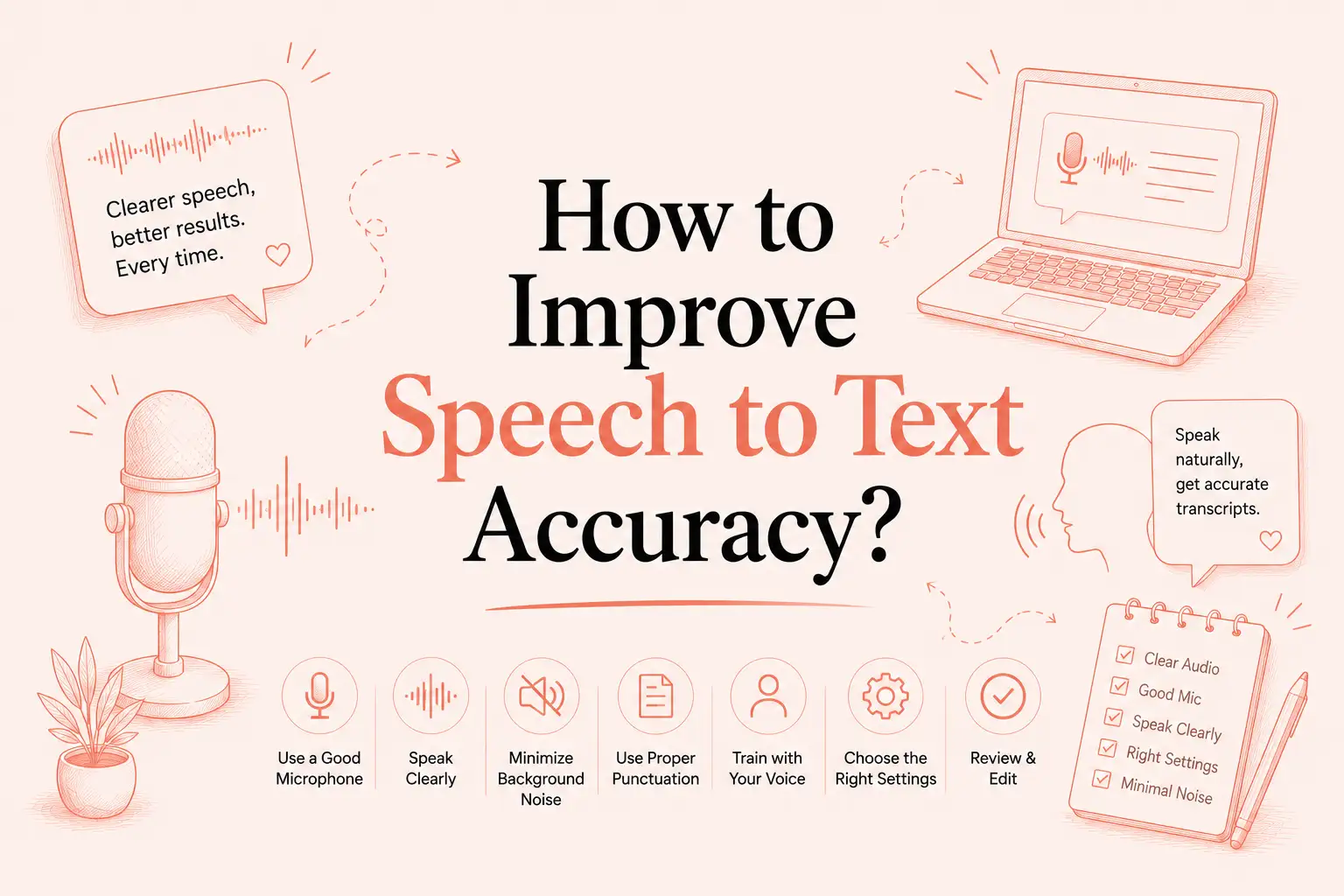
Layer 1: Audio Input Optimization (Immediate 5-15%+ gains)
- Use quality microphones (USB condenser or headset) positioned 6-12 inches from mouth.
- Record in quiet environments; reduce echo with soft furnishings.
- Prefer uncompressed or lightly compressed formats (WAV/FLAC) over heavy MP3.
- For calls: wideband/VoIP beats narrowband.
- Split long files; use voice activity detection.
Layer 2: Model and Mode Selection
Match the engine to the use case. Telephony-tuned models cut errors dramatically on phone audio. Batch/offline processing outperforms real-time streaming on final transcripts because it uses full context. Real-time suits live captions and agents; batch suits records and analytics.
Layer 3: Customization and Prompting (High-ROI)
- Add custom vocabulary / personal dictionaries for names, brands, and jargon.
- Use keyterm or phrase boosting (lightly—over-boosting backfires).
- Provide context (domain, previous turns, agent questions) where supported. One study showed agent context reduced WER 10.2% on voice-agent audio, with larger gains on hard cases.
Layer 4: Post-Processing with LLMs (Major leap in practical accuracy)
Raw ASR output is often flat and error-prone. Modern LLM correction delivers big wins:
- Automatic punctuation, casing, and normalization.
- Multi-stage LLM correction: first pass with language model rescoring + confidence filtering, second pass with targeted LLM editing on uncertain segments. Research shows 10-25% relative WER reduction.
- Filler removal, grammar fixes, and readability improvements.
This is where advanced tools separate themselves. Voicedash combines leading speech recognition with real-time OpenAI-powered refinement. It transcribes natural speech, then automatically removes fillers (“um”, “like”), corrects grammar, adds punctuation, and structures output—all while you speak. The result is not raw transcript but polished, professional text ready to use. It supports 50+ languages with auto-detection and includes a personal dictionary for technical terms and names.
Layer 5: Domain Adaptation and Fine-Tuning (Highest effort, highest reward)
For specialized domains (medical, legal, finance), adapt acoustic and language models on your data. Small targeted datasets often outperform large generic ones. Hybrid approaches (AI first-pass + human review on high-confidence-flagged segments) combine speed and near-perfect accuracy where stakes are high.
Real-World Results and Voicedash in Action
Professionals using optimized systems report:
- 10-25%+ reductions in order/meeting errors in noisy environments.
- Dramatic time savings (dictation at 150 wpm vs typing at 40 wpm).
- Cleaner output that requires minimal editing.
Voicedash implements Layers 1-4 out of the box for everyday professional use. It works system-wide across any application (Gmail, Docs, Word, Slack, Notion, ChatGPT, Claude, Gemini) on Mac, Windows, iPhone, and Android. Users speak naturally; Voicedash delivers accurate transcription plus AI editing that removes fillers, fixes grammar, and formats in real time. Privacy is prioritized via Zero Data Retention with its OpenAI partnership—recordings and transcripts are not stored or used for training.
Compared with basic built-in dictation, Voicedash consistently produces cleaner, more usable text because the LLM layer corrects many errors that pure ASR leaves behind. For teams, it scales with personal dictionaries and snippet libraries while maintaining high accuracy across accents and mixed-language input.
Future Outlook: LLMs and Hybrid Intelligence
LLM integration is the biggest 2025-2026 shift. Models now handle context, intent, and post-correction far better than earlier generations. Expect continued gains in accent robustness, code-switching, emotion-aware transcription, and low-resource languages. The winning systems will combine strong base ASR with intelligent LLM refinement layers—exactly the architecture modern tools like Voicedash deploy today.
Hybrid human + AI workflows remain essential for legal, medical, and compliance use cases where 99%+ verifiable accuracy is non-negotiable.
Practical Action Plan
- Measure your baseline WER on real audio.
- Apply Layer 1 audio fixes immediately.
- Add custom vocabulary and context prompting.
- Introduce LLM post-processing or switch to a tool that includes it natively.
- Test, measure, iterate.
For most professionals and teams, the fastest path to high practical accuracy is an integrated solution that handles transcription and intelligent editing together.
Ready to experience the difference? Try Voicedash free at voicedash.ai. Speak naturally into any app and get polished, accurate text in real time—no training, no workflow changes, strong privacy guarantees.
